The problem
A waste stream that is destroyed, not treated
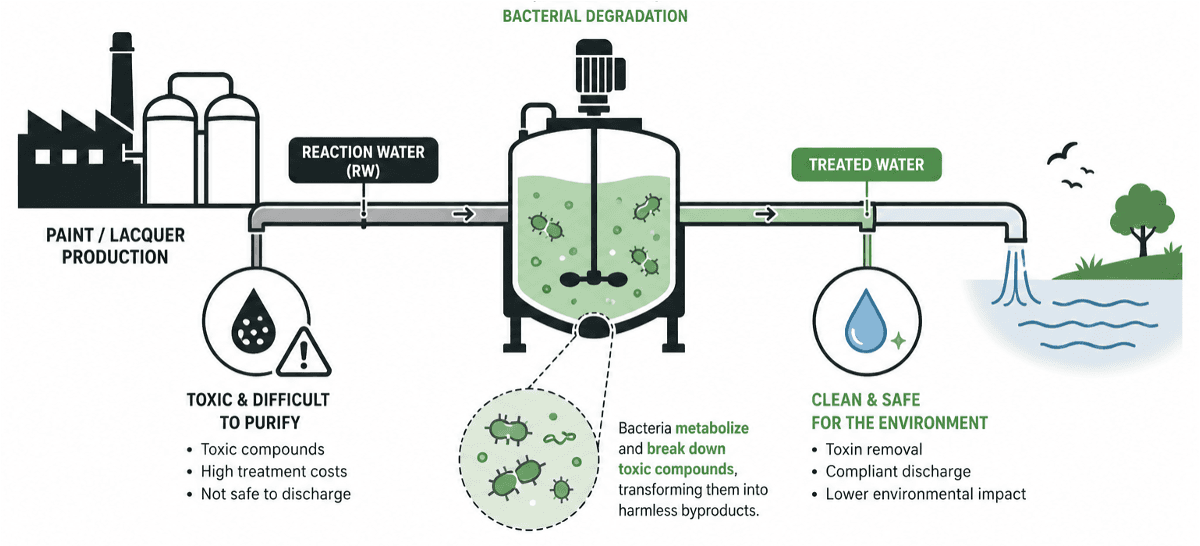
The coatings industry produces reaction water — an aqueous by-product of polyester resin synthesis. At the Kansai Helios Slovenija plant in Količevo, roughly 3,000 tons of it are generated every year. It carries neopentyl glycol, ethylene glycol, unreacted polymer fragments, catalysts, and trace solvents such as butyl acetate, MEK, MiBK, butyl glycol, and xylene.
Today this water is disposed of by high-temperature incineration — an energy-intensive route that destroys the water entirely instead of treating it, and releases CO₂ in the process. The question behind this thesis is simple: can biology do the job instead?

The approach
Evolution under pressure, in a morbidostat
Instead of engineering the organism directly, this work uses Adaptive Laboratory Evolution (ALE). A BSL-1 strain of E. coli 498 is grown in a continuous culture system where the concentration of reaction water is raised automatically whenever the population grows well, and lowered when growth stalls. Over many generations, selection favours cells that can tolerate the toxic constituents — and ideally use them as a carbon source.
The platform is a morbidostat (the open-source Replifactory): a seven-vial device with integrated stirring, optical-density sensing, and three peristaltic pumps that feed medium, dose reaction water, and remove waste. A feedback loop keeps the culture under constant, self-adjusting stress.
Research questions
What the thesis sets out to answer
Can E. coli be evolved to tolerate and grow in increasing concentrations of pH-neutralised reaction water during continuous adaptation campaigns?
Does the adapted culture actively metabolise the toxic constituents, and is degradation stronger under strict catabolism (RW alone) or co-metabolism (RW + glucose)?
How does biofilm formation affect the stability of the process — and can it be leveraged to improve survival against toxic shocks?
Does biological treatment yield a measurable drop in acute toxicity, quantified via EC₅₀ in the Microtox® bioassay (Aliivibrio fischeri)?
Methods at a glance
How it is measured
Status Adaptation demonstrated · validation ongoing
Across the adaptation campaigns, wild-type cultures reached approximately 50% reaction water, while pre-adapted lineages were exposed to concentrations up to 70%. These values describe concentrations reached during the campaigns, not a final validation of stable tolerance. Ecotoxicity validation remains ongoing. Known limitations are handled openly — reaction water absorbs at OD₆₀₀ and can trigger false dilution events at high concentrations, and biofilm can disrupt sensing and clog the waste line.
Why it matters
Aligned with EU sustainability goals
Replacing incineration with biological treatment is not just a lab curiosity — it maps onto several UN Sustainable Development Goals adopted by the EU, and onto the revised Urban Wastewater Treatment Directive and the European Green Deal.